Robot vacuum cleaners are becoming increasingly popular in homes around the world. These compact, disk-shaped devices roam around your floors on their own, picking up dust, dirt, pet hair, and other debris — all while you relax or go about your day. But how do they actually do it? What kind of technology powers their movement and cleaning abilities?
In this article, we’ll break down the science and engineering behind robot vacuum cleaners, explaining how they navigate, clean, and recharge — and why they’ve become such trusted household companions.
1. The Brain and Body of a Robot Vacuum
At its core, a robot vacuum is a small autonomous machine built with a variety of sensors, motors, and software. Its brain is a microcontroller (or a small onboard computer) that processes signals from the sensors and decides how the vacuum should behave.
Its body typically includes wheels for movement, one or more brushes for sweeping, and a vacuum motor for suction. The dust and dirt collected during cleaning are stored in a small bin inside the device, which needs to be emptied regularly.
2. Sensors – The Eyes and Ears
Robot vacuums rely heavily on sensors to “see” the world around them. These sensors help the vacuum navigate and avoid obstacles. For instance, infrared sensors or ultrasonic sensors help detect walls, furniture, and other objects. If the vacuum gets too close, it slows down or changes direction.
Cliff sensors are especially important — they detect stairs or ledges and prevent the robot from falling off. Some models also have dirt sensors, which tell the vacuum when it’s on a particularly dirty area so it can spend more time cleaning there.
These sensors continuously send information to the robot’s processor, allowing it to make real-time decisions on where to move next.
3. Mapping the Home
While early robot vacuums moved around in random patterns, newer and more advanced models use mapping technology to clean more efficiently. This is often referred to as smart navigation.
Some robots use LIDAR (Light Detection and Ranging), which spins a laser on top of the vacuum to map the surroundings in 360 degrees. Others use cameras to recognize objects and build a digital map of your home. More advanced systems use SLAM (Simultaneous Localization and Mapping) technology, which allows the robot to build and update maps while keeping track of its location within the space.
With this technology, the vacuum can clean in straight lines, follow a methodical path, avoid repeating areas, and remember which parts of the home are already clean.
4. Movement and Obstacle Avoidance
Robot vacuums move around using small electric motors connected to their wheels. Most models have two main wheels that allow them to turn and pivot, and sometimes a small third wheel for stability.
As they move, they may bump lightly into objects, such as furniture or walls. Bump sensors detect these impacts and tell the robot to change direction. Advanced models can even slow down when approaching objects, using sensors to gently glide around furniture legs or delicate items.
Some high-end models also use AI-powered object detection, which allows them to recognize small obstacles like socks, phone chargers, or pet waste, and avoid them without physical contact.
5. The Cleaning Process
Now, let’s talk about how the cleaning itself works. Most robot vacuums use a combination of side brushes, a main roller brush, and suction power to clean your floors.
The side brushes sweep dirt from corners and edges into the path of the main brush. The main brush (usually located under the vacuum) rotates to pick up dirt, hair, and debris from the floor surface. It then directs the dirt into the vacuum’s suction path, where it gets sucked up and deposited into the dustbin.
Some vacuums allow you to adjust suction levels depending on the floor type. For example, they may increase suction on carpets and reduce it on hard floors to save battery.
6. Dustbin and Filtration
All the collected dirt and dust is stored in a built-in dustbin, which is usually easy to remove and empty. Most robot vacuums also come with a filter — typically a HEPA filter — that traps small particles and allergens, making the air in your home cleaner.
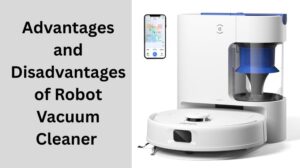
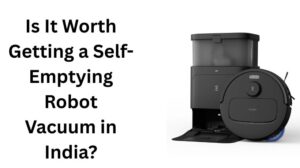
Premium models include self-emptying bins, where the vacuum returns to its charging base and automatically empties its dustbin into a larger disposable bag. This greatly reduces how often you need to manually clean the robot.
7. Mopping Function (in Hybrid Models)
Many robot vacuums today come with mopping capabilities in addition to vacuuming. These hybrid models have a water tank and a mop cloth attached to the bottom. Some even let you control how much water is dispensed depending on the floor type.
More advanced mopping robots use vibrating or oscillating mop pads for scrubbing motion, which helps remove tougher stains on tile or hardwood. Some models also separate clean and dirty water for more hygienic cleaning.
8. Battery Life and Auto-Charging
Robot vacuums run on rechargeable lithium-ion batteries. The battery life varies from 60 minutes on budget models to over 180 minutes on premium ones. Once the battery starts running low, most vacuums automatically return to their charging dock to recharge.
Some robots have a “resume cleaning” feature, which means after charging, they can pick up where they left off. This is especially useful for cleaning large homes or multiple rooms.
9. Smart Features and App Control
Modern robot vacuums are smart home compatible. They often connect to your Wi-Fi and can be controlled via a mobile app. From the app, you can:
- Start or stop cleaning
- Set schedules
- View cleaning history
- Create no-go zones or virtual walls
- Choose specific rooms to clean
You can also use voice commands through smart assistants like Amazon Alexa or Google Assistant to control the robot hands-free.
10. Regular Maintenance
To keep your robot vacuum working efficiently, it needs regular maintenance. This includes:
- Emptying the dustbin regularly
- Cleaning the brushes to remove hair and debris
- Wiping the sensors to ensure proper navigation
- Replacing filters and mop pads as recommended
Most robot vacuums alert you through the app when something needs attention.
Final Thoughts
Robot vacuum cleaners are a brilliant example of how smart technology can simplify everyday chores. Whether you live in a small apartment or a large house, these devices offer hands-free cleaning with minimal effort. By combining sensors, mapping software, cleaning mechanisms, and smart connectivity, robot vacuums are designed to make your life easier.
As technology continues to improve, robot vacuums are becoming smarter, more efficient, and more affordable — turning what once seemed like a futuristic gadget into a household essential.